what are the most important guitar chords to know
If you're new to playing the guitar and wondering what chords are suitable for a beginner guitarist, wait no farther. I've got y'all covered in this lesson… and then some.
[Update] Since I wrote this lesson last year, I've written an accompanying chord book that goes even deeper.
The Beginners Guide to Chords (35 pages) $9.99
You lot'll find no shortage of downloadable guitar chord charts and graphs flying effectually the internet, so what makes this 1 different? Subsequently some 25+ years of educational activity guitar lessons, I've found that the right mix of open position shapes and a picayune music theory goes a long way to understanding more complex and difficult chords in the hereafter for beginning guitarists.
Throughout this lesson I've included links to other guitar lessons (on this website) for reference or more depth on a detail topic. After all, the focus today is beginner chords. I'll do my best to give a brief theory reference that you tin (optionally) read up on to further your noesis later on.
I've also listed the "how" and "why" for each chord type. If you're going to start learning guitar chords, you're probably as well going to want to know which ones sound good together… and why that is.
If you're non interested in guitar music theory, that's ok! At the bottom of the lesson y'all can take hold of a printable 20 Beginner Guitar Chords PDF and get started playing right now.
And then let's take some fun and get correct to it…
Types of Chords in Music
Throughout the lesson you're going to run across names similar "A", "C7", "A sus4 " and more… Let'due south have a quick await at what those names hateful.
Major Chord Types
Whatsoever chord which contains only the 1st, tertiary and 5th notes from the parent (Major) Scale.
For example a "C" chord:
C Major Calibration:
- C
- D
- E
- F
- M
- A
- B
- C
C is the first note, so nosotros'll need that one!
E is the 3rd.
G is the fifth.
Any combination of those 3 notes (and in any gild) will make a C chord.
If y'all but come across a letter name like "C" with no letter of the alphabet or symbol later on, that indicates a Major chord type.
Lets take a look at some Major Chord Types:
If you're a twenty-four hour period one beginner guitarist, chord charts are easy to read.
- The vertical lines are the strings, left to correct, Low Due east-A-D-Chiliad-B-E High
- The Horizontal lines are the frets.
- X = Do not play the string.
- O = Play the string open.
- 1,2,3,four = The numbers of the fretting paw fingers.
If y'all'd similar more information on the Major Calibration and how those are created, check out my lesson on Scales hither: Scales and The Circumvolve of Keys
Minor Chord Types
A minor chord contains the 1st, tertiary and 5th from the Major scale with one big change:
The tertiary is lowered 1 half-stride (semi-tone).
Using the A Major Scale every bit an example:
- A
- B
- C#
- D
- East
- F#
- G#
- A
Lowering the tertiary, C#, 1 half-step gives us a C natural.
- A 1st
- C Lowered 3rd
- E 5th
Modest chords are typically indicated by a lower case "m" such as "Am". Some charts in Jazz will use a minus "-" sign (A-).
Some small-scale chord types:
Wanna dig deeper? Cheque out more guitar chords and how the notes are found on the neck.
How Major and Minor guitar chords work together:
Without getting besides deep into more music theory, information technology is useful to recollect that every Major Key has 3 Major chords and 3 minor chords hiding within.
Using our C Major Scale as an example:
- C Major
- D minor
- Due east minor
- F Major
- Grand Major
- A modest
- B – The 7th is always a Macerated blazon (more on that afterwards).
- C
You can create a song using whatsoever combination of chords in a primal and yous can bet that it's going to audio pretty expert. Some examples in the Key of C:
- "Unproblematic Homo" uses the chords C, One thousand, Am.
- "Dreams" past Fleetwood Mac starts with a uncomplicated F to Thou that repeats throughout the verse.
- "Ain't Talkin' 'bout Dear" by Van Halen is Am to G.
- "Happy Birthday" is – C, G, G, C, C, F, C, G.
You get the idea.. Playing in or around a Primal Center will enable y'all to write songs easily. You lot'll also learn songs easier because you sympathize this chord network that exists in every Key.
Remember – The i-four-5 chords are ever Major chords. The 2-three-half-dozen are always minor. In every key!
Major, minor and Dominant seventh Guitar Chord Types
E'er wonder what that "7" means in a chord name? It indicates the seventh note of the parent Major calibration added to the chord. In this lesson we're going to discuss three types of chords with 7ths added:
- Major seventh – A Major triad (1-iii-5) with a 7th added.
- Minor 7th – A small-scale triad (1-b3-v) with a flatted (1 half-step) 7th added.
- Dominant 7th – A Major triad (1-three-5) with a flatted 7th added.
Ascendant 7th Chords:
So where can we employ these seventh chords? If we use our C Major scale again as an example from which to pull our chords, it looks similar this in every key:
- C – The I (i) tin can always be a Major or Major 7th chord.
- D – The ii (2) can always be a minor or modest 7 chord.
- E – the iii (3) tin always be a minor or pocket-sized 7 chord.
- F – The 4 (iv) can always be a Major or Major 7.
- One thousand – The V (5) can always be a Major or Dominant 7th chord.
- A – The vi (6) can always exist a pocket-size or minor vii chord.
- B – The vii (7) can always be a diminished or minor 7b5 chord.
More Maj7, m7 and Dom7 Chords:
Remember: ANY combination of these chords volition sound pretty skilful together. A common Jazz chord progression includes a ii-5-I. Rock and Pop often use a I, 4, V. Mix and match and run into what you come with.
When you're looking for some chords that go well together, but think of where a chord lies within a particular Major Scale or Cardinal Center.
- Any Major chord could be the 1st, fourth or fifth in whatsoever key.
- Whatever pocket-size chord could exist the second, 3rd or sixth in any key.
With that in mind, a C Major Chord could be used like this:
- Every bit the I in the Primal of C with all of the chords in that central:
C Major, Dm, Em, F, One thousand, Am. - As the IV chord in the Central of Chiliad:
K, Am, Bm, C, D, Em - Equally the Five chord in the Key of F:
F, Gm, Am, Bb, C, Dm.
And then, all small-scale chords could exist placed in a key in a similar way.
Using Am equally an example:
- Am could be the 6th in the Key of C.
- Am could be the 2d in the Key of Chiliad.
- Am could exist the tertiary in the Key of F.
Other Chord Types
Y'all may take seen chords with names such as "Asus2" or "Dsus4". These are Suspended Chords.
The easiest manner to call up of a Suspended Chord is to simply recall of the number that follows as replacing the 3rd in the scale.
A sus2 – A Major chord (1-3-v) with the third replaced by the 2nd annotation in the scale.
D sus4 – D Major chord with the tertiary replaced by the fourth from the scale.
Because of this 3rd scale tone omission, it'southward safe to apply suspended chords as either Major or minor chord types as the 3rd is what defines Major or minor. Lets accept a await at some examples:
Add9 Chords
The Cadd9 is a very useful and common chord. The proper name "add9" means exactly what you call back it ways. We only add the 9th note in the C Major Scale to the existing Major Chord form.
- C
- D
- E
- F
- One thousand
- A
- B
- C
- D (9th)
C add9 = ane+three+5+9
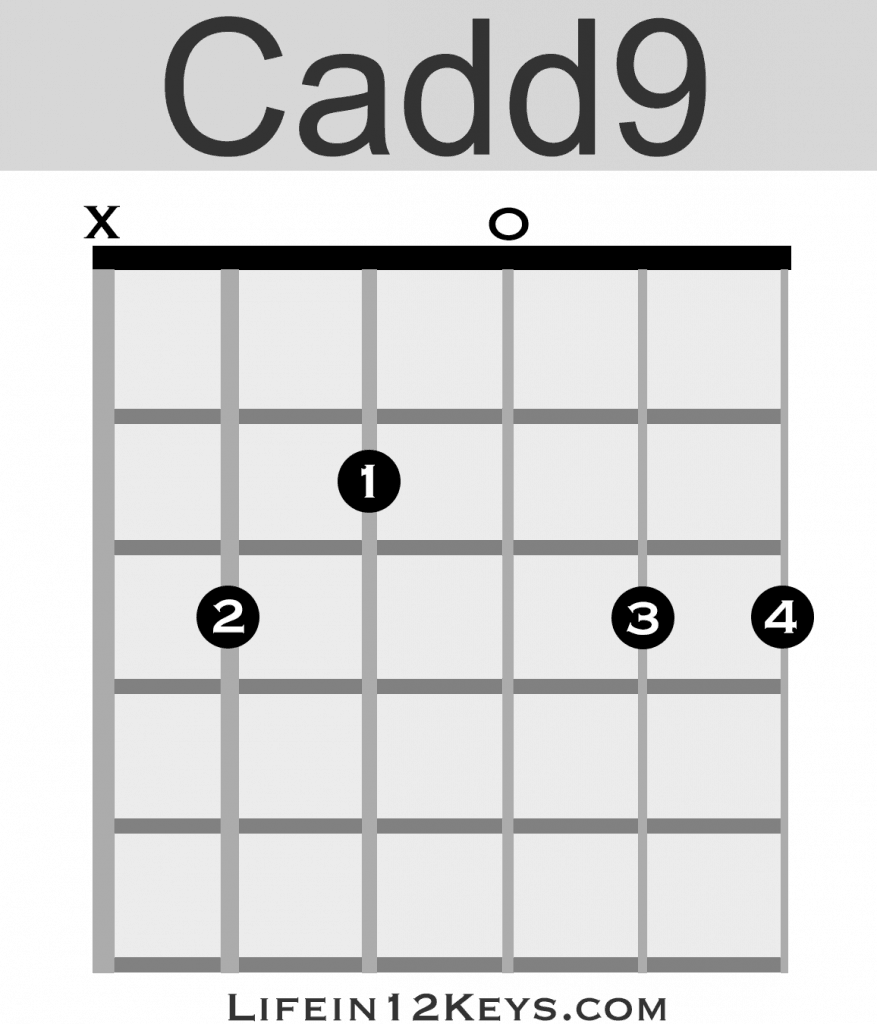
Yous're probably thinking, "ok isn't the 9th just a 2nd?" Well, yes and no.
In Music theory the 9th refers specifically to the 2nd scale tone, but one octave college, which is how we get the proper name "9th".
The Barre Chord
A barre chord refers to any chord that requires you to cover 2 or more strings with ane finger. Typically your 1st or 3rd fingers on the fretting hand. Allow's take a look at everyones beginning barre chord, the F Major.
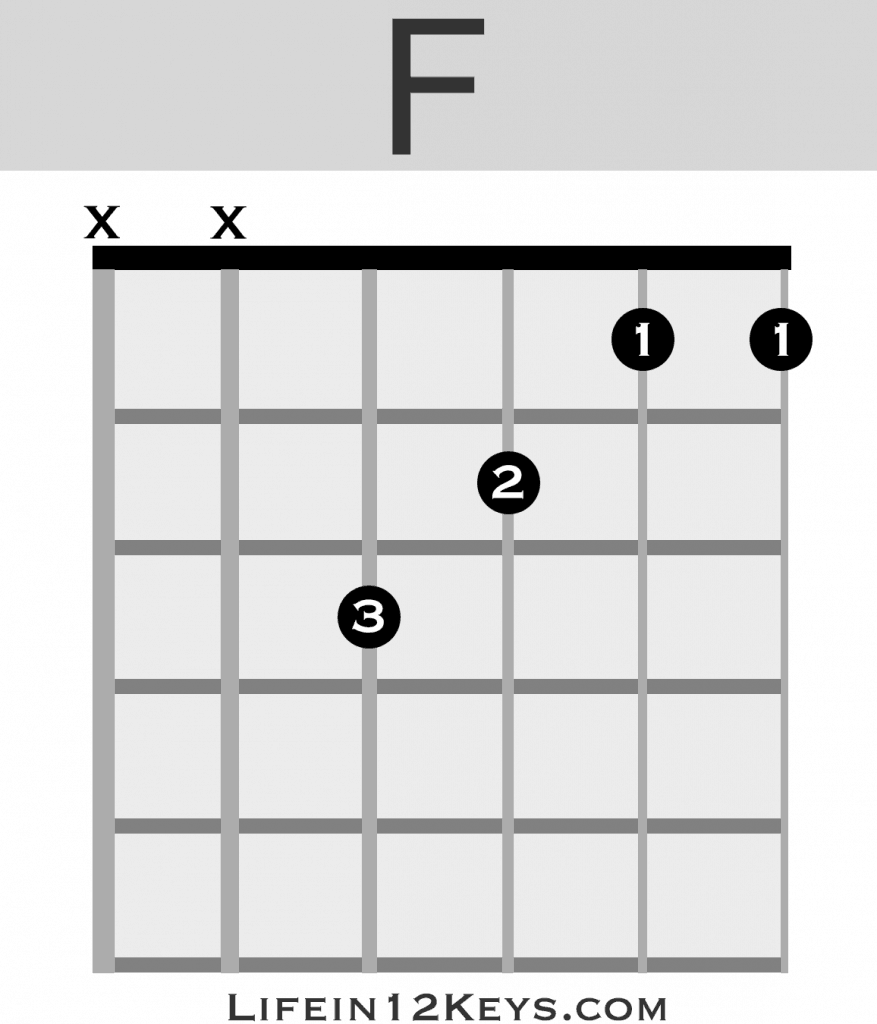
There are a few ways to approach barre chords depending on the size and shape of your hands and fingers. Typically, beginner guitarists will have the most success with the F chord if they bending the 1st finger slightly inward (pointing toward the 2d fret expanse).
Some Last Thoughts
I've always found that there are 2 types of guitarists out in that location:
- Those that simply want to have fun and play.
- Those that need to know how everything works.
I've always been a #2 blazon, but that doesn't mean yous have to exist. The music theory in this lesson is completely optional and should exist digested slowly while having fun learning some chords and songs.
If you're more like me and desire to delve even deeper into all of this stuff, here are some other lessons on the website that will have you farther in your musical journey.
- Chords 101, Including how to build your own guitar chords and find the notes on the neck.
- Guitar Chords as office of my vii Day Practice Routine.
- Strumming and Accompaniment – Easy Beginner Guitar Songs
- Scales and The Circle of Keys – Essential for putting chords together in Central!
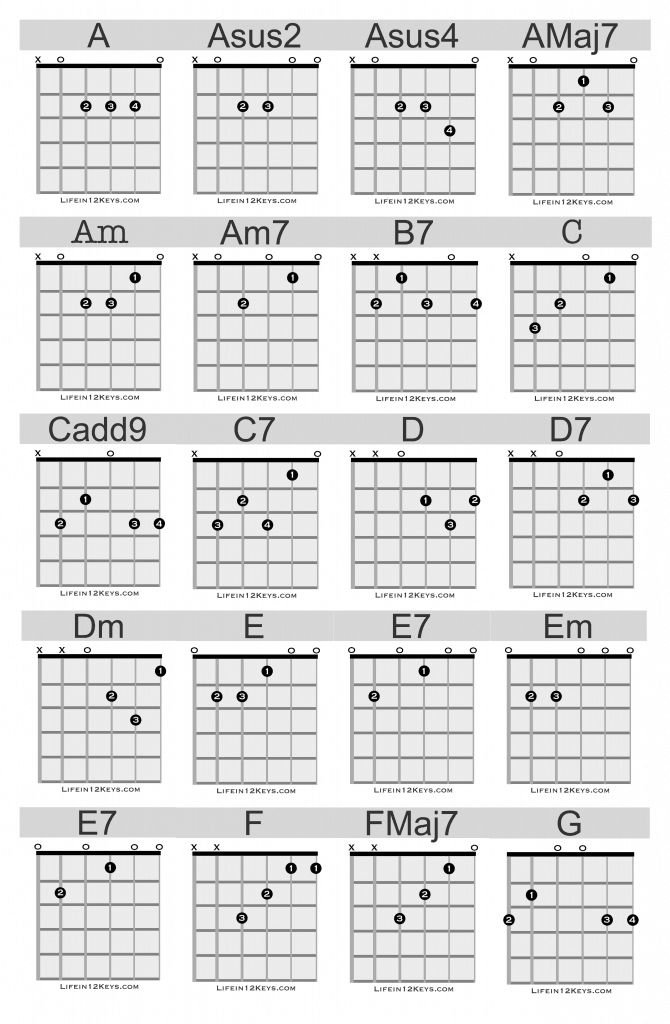
Lastly, hither is a downloadable PDF of all the chords listed above for easy reference and practice.
Beginner Guitar Chords PDF
In the next lesson, I'll cover more than chord types including barre and "power" chords too as some strumming and rhythm patterns.
Until next time,
Craig


Craig Smith is a professional Guitarist, Teacher, and Author living in Sanford, Florida. Craig has taught guitar lessons, performed 200+ gigs per year for near xxx years, and published 4 guitar instructional books. When he'south not gigging or writing, yous may find him by the puddle with his wife Celeste, 4 Chihuahuas, and a potable. 🎸
Source: https://lifein12keys.com/20-essential-guitar-chords-for-beginners/
0 Response to "what are the most important guitar chords to know"
Post a Comment